
Inside the Haunted Beauty of 7:42 PM. The Art of Chris Mars: A Conversation Between Chris Mars and S.W. Lauden
Jan 6th 2026
S.W. Lauden: 7:42 P.M. is a truly impressive collection. Can you share a little about how this project came together and how the specific works in this book were selected?
Chris Mars: Thank you! The paintings included in 7:42 P.M. represent a continuation of the chronology of my work. My previous book, Tolerance, featured paintings from about 2000 to 2008. 7:42 continues with paintings from that point until the layout of the book was complete! In each case, there wasn’t much if any editing—I chose to include pretty much every painting I created. I did this because genuine truth is rarely an edited version of the truth. And this work, it’s my truth. So it’s all in there.
In the book you describe life, and by extension your art, as "sedimentary—that everything we have ever been we still are, only with more and more layers..." Do you have a sense of the new layers your artwork has accumulated since Tolerance was published?
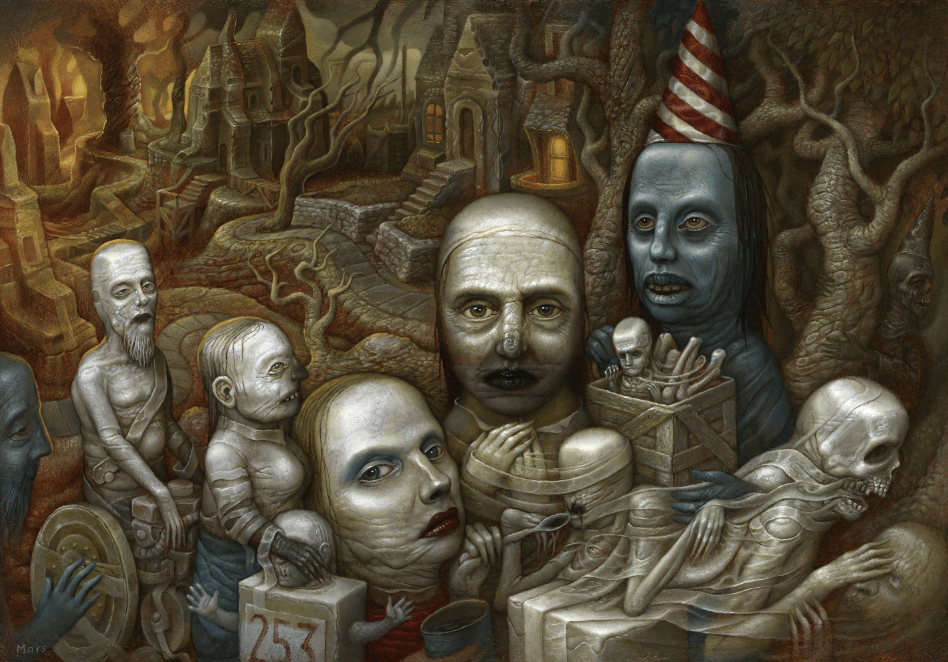
While the themes explored in my work—along with the emotional content, technique and aesthetic—continue across the body of work overall, within 7:42 P.M. the layers of life experience, growth and perspective do shift. New “layers” would, to me, include less anger in the work (or maybe less direct, obvious anger), an older human’s perspective on life (my own, and others’, and just the sense and shape of life outside of my own as well). Also, the work in 7:42 P.M. comes perhaps more confidence in technical execution of a painting. I think color itself has become—along with those other new layers—an additional way to lure a viewer into a painting—a painting in which I might be asking them to explore something a viewer may or may not be fully attracted to or comfortable with. The paintings in 7:42 P.M. are overall more colorful. There is personal satisfaction in using color in a different way than say the work embodied in the previous book. I feel braver with color, and probably braver as a painter in general.
|
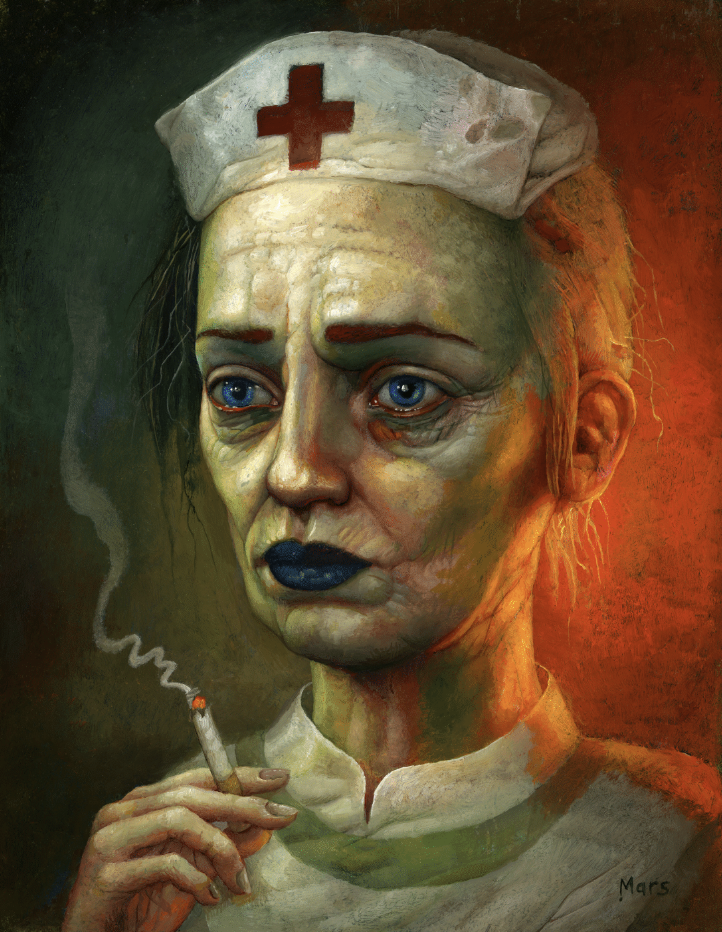
I was really struck by the repeated hospital/healthcare theme in your paintings. Can you talk a little about what the red cross symbol means to you and how your relationship with it has evolved over time?
In general, I like how the red cross looks aesthetically. I’ve been known to use them and other letter, numbers or “symbols” as purely graphic elements. But also yes, I have in my work explored medical themes, especially fiscal exploitation and industrial abuses in the field, often connected to themes and causes inspired by my brother Joe, who lived with schizophrenia…the institutionalization of care, medication and over-medication, and social stigmas that presented themselves with his experiences and in his life. I can connect the red cross as a symbol to negative or positive aspects of the medical field; negatively with my painting "Dr. Glaxo", who I see as a sort of greed-forward character, or positively with "Seen Too Much", which depicts an exhausted nurse during the covid years. But again, I just like it as a design element as well!
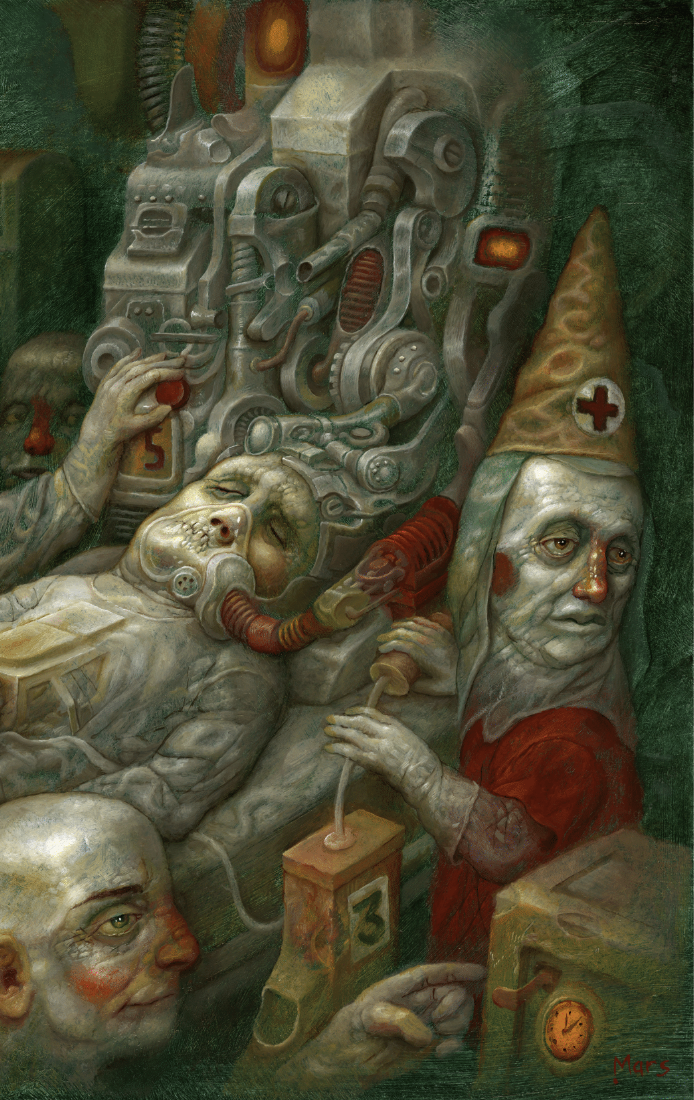
I kept returning to "The Cure-All" while exploring 7:42 P.M. There's something really gripping about the dying patient at the center of the painting, while everybody else in the room looks away (mostly at the monitor). Was there a specific inspiration for this theme and composition?
This would be another positive inclusion of the red cross symbol and this is another painting directly influenced by the horrors and heroism of the pandemic years. I hope I somehow honored and did justice in any way to the many we lost during that time and the heroes who cared for them. Hard to avoid expressing myself on the subject. It really did come close to all of us.
I was also really drawn to your Hanford series. How did that particular WWII/Cold War environmental catastrophe get on your radar? Why do you think it moved you to create so many works?
Initially I saw a documentary about the Hanford Site, one particularly focused on its impact on the residents of Yakima Valley. From there I took a deep dive. I informed myself about what has been an ongoing environmental catastrophe in and around Hanford, Washington, and the toxic waste that is still buried there. More recently, the government has made effort to contain and abate the contamination. But I was astounded that for literally decades, birth defects and cancer rates among the "Down-winders" who lived near Hanford Site were heartbreakingly high, with residents crying out for help, for acknowledgement. So I wanted to make my own world around the subject, as a document to honor those who suffered.
In that series, and throughout the book, your handling of human eyes carry a lot of emotional resonance. Is that where you start with your paintings (and build outward) or are eyes more often a finishing touch?
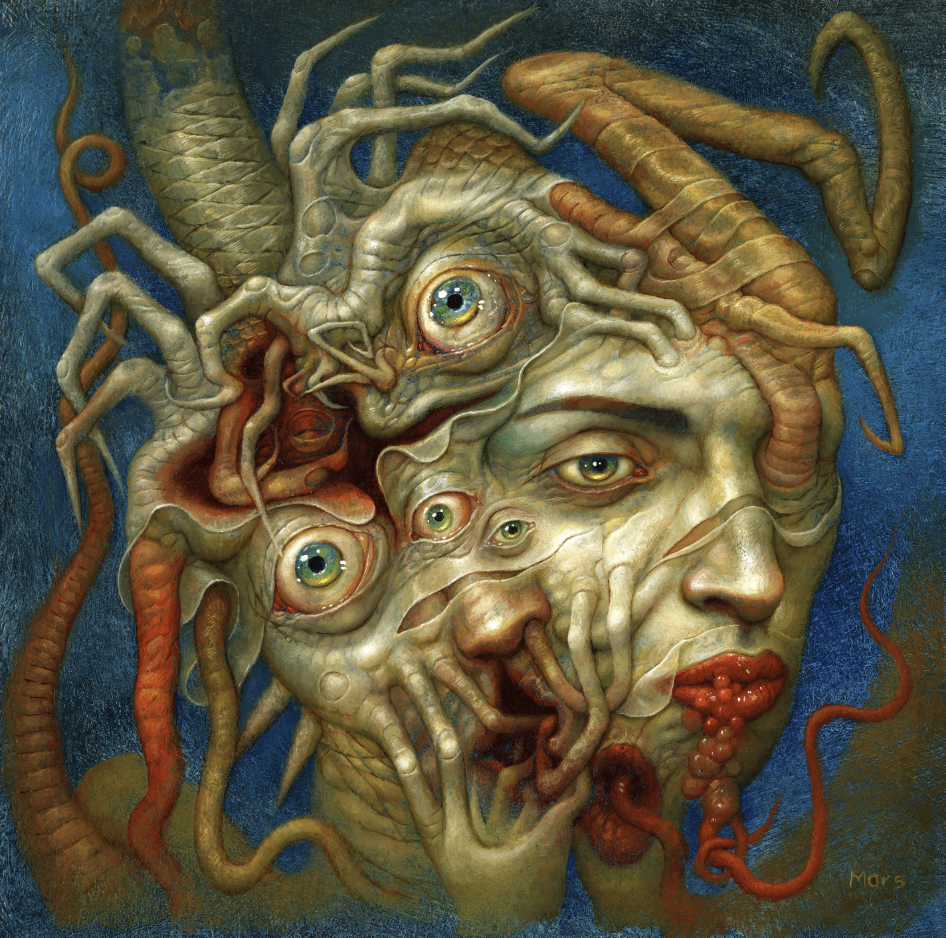
Eyes for me and in general say so much. I do like to make them a strong element in my paintings. They can immediately reflect an emotion, connecting directly with a viewer and setting the tone for the story of the painting. And yes, I often do start by painting the eyes and building around them…if not the eyes, then of all things I start with the nose, then build up and out to the eyes. When I was quite young, I drew a horse for my dad—he loved horses. He appreciated it, but he said, “The horse’s eyes look dead.” He was right, too. I evidently took that criticism to heart…I always make sure now that the eyes I paint are fully alive. My dad is partly responsible for them…thanks Dad!
What's next for you?
I will continue to paint, make music, animations and short films. For me, jumping between these different forms of expression becomes an asset to painting, which I love the most and which comes most naturally to me. The other art forms are so laced with technical consideration—tech, software—that when I go back to painting, I'm extra grateful for how direct and organic the painting process is. Not that I need the contrast of these other forms of expression to highlight the wonder and joy of painting—it’s what I’ve always, always wanted to do, from the time I first encountered “P” for “Paintings” in the World Book Encyclopedia. I have this distinct compulsion to create in some way every day. Being able to vary the medium to music or filmmaking is like taking a little trip…it’s nice, but the best part is always coming back home. Painting is home to me.
S. W. Lauden is the editor of Forbidden Beat: Perspectives On Punk Drumming. He's also the co-editor of Go All The Way: A Literary Appreciation of Power Pop and the sequel, Go Further. His Greg Salem punk rock PI series includes Bad Citizen Corporation, Grizzly Season, and Hang Time. Steve's a father, husband, writer and drummer living in Los Angeles. Find him on Substack at Remember The Lightning. Instagram: @swlauden.