


Hailed by Thomas Pynchon as “daringly imagined and darkly romantic—a moral thriller,” Destiny Express captures both the glamour and the terror of an era, dramatizing the perilous moment when art, politics, and destiny converged on the tracks out of Berlin.
Berlin, the last day of February, 1933. The Reichstag lies in smoldering ruins, a new world about to spring from its ashes. And now for German filmmakers the choices are stark: stay and collaborate with a government that believes in cinema’s power to shape reality, or leave everything behind. Destiny Express is the story of Fritz Lang and Thea von Harbou, husband and wife, director and screenwriter—together, they made some of the greatest films of all time: M, Metropolis, Doctor Mabuse. As each day is torn from the calendar they watch as one by one Bertolt Brecht, Max Ophuls, Billy Wilder, take the next train out. Destiny Express follows Lang, von Harbou, and a host of real and fictional others––novelist-turned-
Harsh lights, long shadows: the perfect setting for a deeply researched, deftly imagined tale, as one character puts it, of "crime, gambling, cocaine, jazz, stock exchange maneuvers, smuggling, hypnosis, counterfeiting, violence, Expressionism." Destiny Express is the story of a marriage at the end of its passion, at the edge of history—all at the end of an era when film was to mean more than it ever would again.
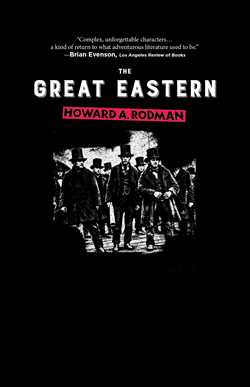
Howard A. Rodman is the author of the novels Destiny Express and The Great Eastern. His work has appeared in The New York Times, The Los Angeles Review of Books, Black Clock, and elsewhere.As a screenwriter his films include Joe Gould’s Secret; August with Josh Hartnett, Rip Torn, and David Bowie; and Savage Grace with Julianne Moore and Eddie Redmayne.On television, he’s written for Fallen Angels and staffed on HBOMax’s The Idol.
He’s a vice president of the Academy for Motion Picture Arts and Sciences and a past president of the Writers Guild of America West.Rodman is one of seventeen members of the Screenwriters Hall of Fame, and was knighted by the Republic of France as an Officier de l’Ordre des Arts et des Lettres.
As an academic, Rodman is professor and former chair of the division of screenwriting at USC; as a journalist, he’s published hundreds of articles beginning with his tenure as editor-in-chief of the Cornell Daily Sun.In 2011 Rodman organized the nationwide Fantômas centennial, and remains on the steering committee of NOIRCON.Those who lived through the post-punk era in lower Manhattan may have seen him play guitar with the bands Arsenal and MADE IN USA.A proud son of Bedford-Stuyvesant, Rodman currently lives in Los Angeles.
![Scale [signed] by Keith Buckley](https://cdn11.bigcommerce.com/s-mgusnzjr16/images/stencil/500x659/products/170/1459/Scale_US_Paperback_Cover_2D__49140.1748133050.png?c=1 "Scale [signed] by Keith Buckley")

![The Dreamers [signed] by Ryan Elizabeth Penske](https://cdn11.bigcommerce.com/s-mgusnzjr16/images/stencil/500x659/products/561/1685/9781644284063_FC__47405.1752875972.png?c=1 "The Dreamers [signed] by Ryan Elizabeth Penske")
![This Isn't 40 [Signed] by Scott Caan](https://cdn11.bigcommerce.com/s-mgusnzjr16/images/stencil/500x659/products/225/1185/9781644281369_FC__82013.1689120551.jpg?c=1 "This Isn't 40 [Signed] by Scott Caan")